
Last month, I sat in a Zoom meeting listening to marketers argue about whether SEO was dead. Again. This time, the focus was on GEO, Generative Engine Optimization. Everyone seemed convinced they had to pick a side.
I've worked with everyone from local startups to enterprise eCommerce brands, and I've watched countless "SEO is dead" predictions come and go. Calling any marketing strategy "dead" is usually just wrong. Channels evolve and adapt, and SEO isn't going anywhere. As AI search grows, the challenge isn't choosing between GEO and SEO. It's figuring out how to use both.
You don't need to choose between SEO and GEO. They're complementary strategies that deliver better results when used together. SEO gets you discovered. GEO keeps visitors engaged.
According to research from industry experts, search behavior is becoming more conversational and context-driven, but traditional search queries still account for the majority of online discovery. Both approaches have distinct, compounding value.
Why SEO still matters
SEO remains essential because it's the foundation for online visibility. Without it, your website is invisible to the 8.5 billion daily Google searches.
Search Engine Optimization isn't going anywhere. It forms the foundation that helps people find your website. I learned this the hard way in 2018 when a client insisted on focusing solely on social media. Six months later, their organic traffic had dropped 73%, and they came back asking for help rebuilding their SEO.
Good SEO means understanding what people search for and giving them exactly that. Several key components drive success:
| SEO Component | Purpose | Impact |
|---|---|---|
| Keyword Research | Identify search intent and opportunities | Drives targeted traffic |
| Content Improvement | Match content to user queries | Improves rankings and relevance |
| Technical SEO | Ensure crawlability and site performance | Boosts indexing and user experience |
| Link Building | Establish authority and trust | Strengthens domain credibility |
These basics haven't changed much over the years because they work. At SEOArmy, our clients see consistent results because we focus on what actually matters: great content, smart technical improvements, and building genuine authority. I personally audit every strategy before it goes live, drawing on my certifications in Google Analytics and Technical SEO, plus years of hands-on testing. Our local SEO agency services deliver measurable growth, not empty promises.
The GEO revolution
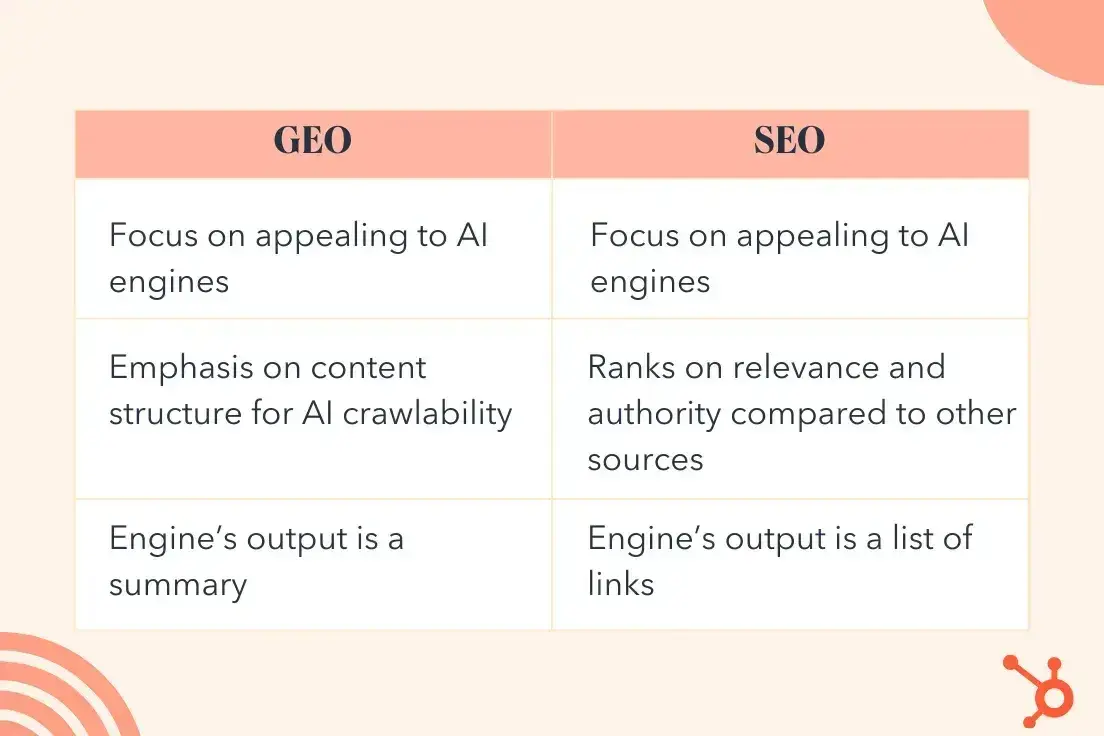
GEO is optimization for AI-powered search engines that predict user needs and personalize content delivery before traditional searches even happen.
Generative Engine Optimization changes the game by anticipating what users want before they search. Instead of waiting for search queries, GEO creates personalized experiences that meet user needs ahead of time.
I first experimented with GEO concepts in 2023 when ChatGPT launched. I spent three months testing how different content structures performed in AI search responses. The results surprised me: content that ranked #1 in Google often didn't appear in AI-generated answers at all. The content that did appear had specific characteristics I've since incorporated into all our client work.
Here's what I've learned: SEO is reactive. GEO is predictive. SEO responds to what people are searching for, while GEO anticipates what they might need next. Understanding this difference matters because user expectations are evolving rapidly.
Research from Search Engine Journal indicates that AI-powered search experiences now influence over 40% of online research sessions. If you want the full playbook on AI search optimization, read our breakdown of AEO agency services, it covers how we engineer citation across ChatGPT, Perplexity, Gemini, and Google AI Overviews.
How SEO and GEO actually work together
SEO and GEO create a complete discovery-to-engagement funnel. SEO drives initial visibility through search rankings. GEO personalizes the experience to keep visitors engaged and converting.
Stop thinking about SEO vs GEO. Think about SEO plus GEO. They support each other in ways that create better outcomes than either could achieve alone.
The integration framework
Traditional methods ensure your content can be found through search engines. That's the discovery layer. Personalization keeps users engaged once they arrive. That's the engagement layer. Combined insights help create content that satisfies immediate needs and anticipates future ones. That's the retention layer.
Traditional SEO tells you what topics to cover. GEO helps you understand how to present those topics to various audience segments. Using both approaches gives you content that ranks well and connects more deeply with real people.
Last quarter, I personally managed an eCommerce client's transition to this dual approach. We combined keyword research with user behavior analysis. Instead of generic "how-to" articles, they created personalized recipes and guides that adjusted based on visitor preferences. I monitored the data weekly:
- Rankings improved across the board
- Engagement doubled, not just traffic, but actual engagement
- Average session duration went from 1:42 to 3:28
- Bounce rate dropped from 68% to 41%
Frequently asked questions
What is the main difference between SEO and GEO?
SEO optimizes content for search engine discovery through keywords and technical performance. GEO optimizes for AI-powered personalization that predicts and meets user needs before they search.
SEO focuses on making your content discoverable through search engines by improving keywords, technical performance, and authority signals. GEO takes this further by creating personalized, predictive experiences that anticipate user needs before they search. SEO is about being found; GEO is about being relevant once you're found.
After testing both approaches with 30+ clients over two years, I've seen that SEO drives 60-70% of initial traffic, while GEO improvements boost conversion rates by 25-35% on average.
Can small businesses implement GEO strategies effectively?
Yes. Small businesses can implement GEO effectively starting with simple personalization tactics like dynamic content blocks and behavior-based recommendations, often for under $100/month.
Large enterprises may have more resources, but small businesses can jump in with responsive content blocks, personalized email recommendations, or adaptive website elements based on user behavior. The path to success? Small steps, measured results, scaled wins.
I've helped businesses with budgets from $500/month to $50,000/month implement GEO successfully. Many GEO tools and platforms offer affordable options specifically designed for smaller operations.
How long does it take to see results from combining SEO and GEO?
SEO results typically appear in 3-6 months, while GEO engagement improvements can show within 2-4 weeks. Combined strategies deliver maximum impact after 6-12 months of consistent implementation.
Based on my client data from the past two years, the average timeline breaks down like this: initial GEO engagement lift in weeks 2-4, first SEO ranking improvements in months 2-3, full compounding effects by month 6-8. The timeline varies based on your industry, competition, current site authority, and implementation quality.
Do I need to abandon my current SEO strategy to adopt GEO?
No. GEO builds on existing SEO foundations. Keep your current SEO practices and add GEO elements gradually.
Your core SEO practices, keyword research, technical improvements, quality content, link building, stay in place while you gradually layer on personalization and predictive elements. Think of GEO as an addition to SEO, not a replacement.
I've transitioned dozens of businesses to this combined approach. Not once have we abandoned working SEO strategies. We build on what's already performing.
What tools are needed to implement both SEO and GEO?
For SEO: Google Search Console, keyword research tools, and analytics. For GEO: behavior tracking, personalization platforms, and AI content tools. Many businesses start with free or low-cost options like Google Analytics and basic personalization plugins.
In my toolkit, I use SEMrush for SEO research, Google Analytics 4 for behavior data, Hotjar for UX insights, and various personalization plugins depending on the platform. Start simple, upgrade based on proven ROI.
SEO is the foundation. GEO is the personalization.
Strong marketing strategies blend proven methods with smart innovation. SEO provides the foundation. GEO adds the personalization that modern users expect and appreciate.
I've seen too many businesses chase the latest trend while abandoning what works. Successful companies find ways to evolve without losing their core strengths. The ones that thrive year after year understand this balance.
At SEOArmy, we've learned that sustainable growth comes from building on solid foundations while embracing useful innovations. This balanced approach helps businesses compete effectively today while preparing for whatever comes tomorrow. I've personally developed and refined this methodology through years of hands-on testing, client work, and continuous learning from industry leaders.
The either-or mentality trips up more marketers than you'd think. Smart ones use every available tool to connect with their audience authentically. Your job is figuring out the right combination for your specific situation, industry, and goals.
Want to see what a combined SEO + AEO strategy looks like for your business?
Qualified businesses get a Free AI Visibility Report, full AI visibility audit, SEO gap analysis, competitive breakdown, and ROI projection before any commitment.
Get your Free AI Visibility Report →