


Search has quietly changed underneath everyone's feet. Your buyers no longer start every journey by typing a phrase into Google and scrolling through ten blue links. They ask ChatGPT to recommend a provider. They run a comparison in Perplexity. They read Google's AI Overview at the top of the page and make a decision before a single organic result loads. As of early 2026, AI Overviews appear on close to half of all Google searches, up from a small fraction the year before.
That shift creates a new question for every business: it is no longer enough to rank. You have to be the answer. Answer Engine Optimization, or AEO, is the discipline built around that goal, and a growing number of agencies now offer it. This guide explains what AEO actually is, how it relates to GEO and traditional SEO, what a competent AEO agency should do for you, the questions to ask before you hire one, the red flags to avoid, and how to get started without betting your whole budget on a slow-moving channel.
What is AEO (Answer Engine Optimization)?
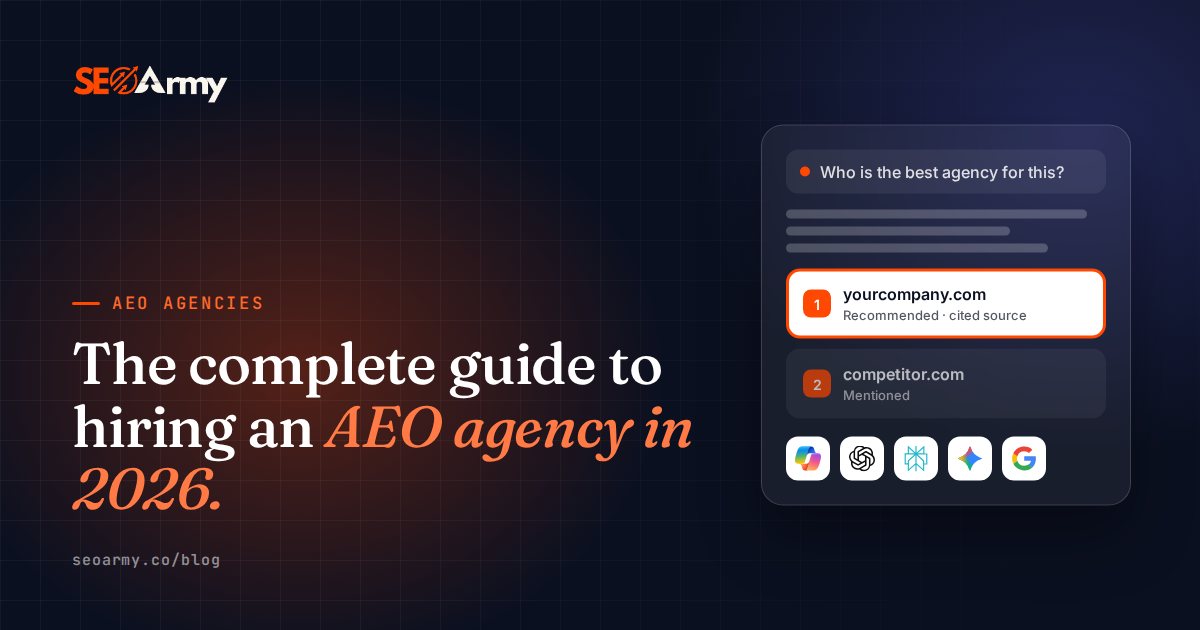
AEO is the practice of optimizing your content, brand, and authority so that AI answer engines cite and recommend your business when someone asks a relevant question.
The engines that matter right now are ChatGPT, Perplexity, Google's Gemini, and Google AI Overviews. Instead of returning a list of links and letting the user choose, these systems read across many sources and synthesize a single answer. If your business is one of the sources that answer draws from, you win attention at the exact moment a buyer is forming an opinion. If you are not, you are invisible, and you often will not even know it is happening because there is no rank to check.
This is why AEO has moved from a niche curiosity in 2024 to a board-level concern in 2026. The behavior is real, the volume is large, and the buyers using AI to shortlist providers tend to be high intent.
AEO vs. GEO vs. SEO: what is the difference?
These three terms get used interchangeably, but they describe different things, and understanding the distinction helps you hire well.
SEO, or Search Engine Optimization, is the established practice of ranking your pages in traditional search results. The target is the results page, and success has historically been measured in rankings, clicks, and organic traffic.
AEO, or Answer Engine Optimization, targets the answer itself. The goal is to be the cited, recommended source inside an AI-generated answer, whether that answer appears in ChatGPT, Perplexity, or Google's AI surfaces. Success is measured in citations, mentions, and inclusion, not just blue-link rankings.
GEO, or Generative Engine Optimization, is closely related and often used as a synonym for AEO. Where people draw a line, GEO tends to describe optimizing specifically to be referenced inside generative AI outputs across the broader ecosystem of large language models, while AEO is often framed around answer-style queries. In practice the work overlaps heavily. Our complete guide to Generative Engine Optimization goes deeper on the tactical side if you want the full playbook.
These are not separate, competing strategies. They share a foundation, and the smartest approach treats them as one connected effort rather than three siloed services.
Why you still cannot ignore traditional SEO and brand
Here is the part a lot of the newer AEO-only pitches get wrong, and it is now backed by Google itself.
In 2026 Google published its first official documentation on optimizing for generative AI features, and the core message was blunt: AI Overviews and AI Mode are not running on a separate system. They draw from the same index that powers traditional search. Industry coverage summarized Google's position as AEO and GEO being, fundamentally, still SEO. There is no secret AI index and no separate AI ranking algorithm you can game in isolation.
What that means practically is that traditional SEO fundamentals are the foundation of AI visibility, not a legacy concern you can skip. Strong, authoritative, well-structured content is what makes you citable. On top of that, the engines lean heavily on brand and entity signals: the consistency, authority, and recognition of your business across the web. Content that leads with clear answers, is genuinely authoritative, and comes from a recognized brand is far more likely to be pulled into an AI answer.
This is the single most important thing to understand before you hire anyone. An agency that sells you AEO in a vacuum, with no attention to your SEO foundation or your brand, is building on sand. Optimizing for traditional brand authority has become just as important as optimizing for keywords, because the two now feed each other.
Our approach: AI search and traditional optimization, combined
We pivoted our model in 2025 for exactly this reason. Rather than chasing AEO as a shiny standalone offering, we built an approach that combines AI search optimization with traditional SEO and brand optimization, because that is what the engines actually reward.
The logic is a reinforcing loop. Traditional SEO builds the authority and indexable content that AI engines draw from. That authority makes you more likely to be cited in AI answers. Those citations and your growing footprint strengthen your brand signals. Stronger brand signals make you more likely to be cited again. Pull any one piece out and the loop weakens. Run all of them together and they compound.
This is why we do not pitch AEO services as if AI search exists on its own planet. We optimize for the way search works in 2026: a blend of classic ranking, answer-engine citation, and brand authority, treated as one strategy.
How we de-risk it: pay-for-performance lead generation first
There is an honest truth about SEO and AEO that most agencies bury in the fine print: it is a longer-term play. Meaningful organic and AI-search traction typically takes around twelve months to build. That is fine if you understand it going in, but it is a hard sell if you need growth now and you are being asked to pay a retainer for a year before you see much.
So we solve it differently. We start a pay-for-performance lead generation program at the same time as the SEO and AEO work. The lead gen drives new growth immediately, on a flat per-lead or per-call basis with no management fee, so you only pay for results while the longer-term search assets compound underneath. You get near-term pipeline and a long-term moat, started together, instead of choosing one or the other.
Near-term pipeline from pay-per-lead, plus a compounding AI-search moat underneath. You do not have to choose one or the other, and you do not pay a management fee on the lead gen.
If you want the full breakdown of how the pay-for-performance model works, see our performance offer page for the complete structure.
What a great AEO agency actually does
When you evaluate agencies, this is the work that should be on the table.
A real AEO engagement starts by auditing your current AI visibility. Are you being cited today, and where? Across which engines and which queries? Without that baseline, everything else is guesswork.
From there, the agency should build authoritative, answer-shaped content that directly addresses the questions your buyers ask, structured so an AI system can extract and cite it cleanly. They should strengthen your brand and entity signals so the engines recognize you as a trusted source. They should maintain the traditional SEO foundations, technical health, and topical authority that AI visibility is built on, because Google has confirmed these are the same systems. And they should measure success in citations and mentions across engines, tied back to actual business outcomes, not vanity metrics.
If an agency cannot describe this end to end, they are selling a buzzword.
Questions to ask before you hire an AEO agency
Use these on any sales call:
- How do you measure AEO success? You want to hear about AI visibility and citation tracking across engines, not just keyword rankings.
- Do you also handle traditional SEO and brand, or AEO in isolation? The right answer is that they are inseparable.
- What is your reporting cadence, and what exactly do you report on? Look for outcomes and visibility, not impressions.
- How long until results, realistically? An honest agency will tell you AI and organic search take months to compound and will not promise overnight wins.
- Do you lock me into a long contract? Long lock-ins with no performance accountability are a warning sign.
- How have you adapted your approach since AI search took off? If they cannot describe a concrete shift since 2025, be cautious.
Red flags to watch for
Be wary of any agency that guarantees instant AI rankings or specific placement inside ChatGPT or AI Overviews. No one controls AI outputs with that precision, and Google's own documentation warns against the tactics some AEO sellers push.
Be equally wary of AEO sold with no SEO or brand foundation, vague reporting built on vanity metrics, long lock-in contracts with no accountability for results, and any agency that cannot give a clear answer on how it attributes outcomes to its work.
What should AEO cost?
Pricing models range from monthly retainers to performance-based arrangements, and what is right depends on your situation. The thing to interrogate is not the number, it is the accountability behind it. A large retainer with opaque deliverables and no clear link to results is the riskiest way to buy.
Our own answer is to align incentives: pay-for-performance lead generation funds near-term growth, while the SEO and AEO work builds the compounding long-term layer. You are not handing over a blank check for a year and hoping. You see results from the lead gen quickly, and the search assets mature alongside it.
How to get started
The cleanest first step is to find out where you actually stand. Start with a free AI Visibility Report, which shows exactly how your business shows up across ChatGPT, Perplexity, Gemini, and Google AI Overviews today, along with a prioritized roadmap. From there we run a quick mutual fit check, and if it is a match, we get to work.
Want to see where you stand in AI search before you hire anyone?
Get a free AI Visibility Report showing exactly how your business shows up across ChatGPT, Perplexity, Gemini, and Google AI Overviews, plus a prioritized roadmap. Then we run a quick mutual fit check. If it is a match, you only pay for the results we deliver.
Check your fit & request your report →You can check your fit and request your free AI Visibility Report here, or call us directly at (833) 407-1900.
If you manage properties in the travel space, you may also want to read our guide to vacation rental SEO and marketing, which applies this same combined AI-search-plus-traditional approach to driving direct bookings.
Frequently asked questions about AEO agencies
What is AEO (Answer Engine Optimization)?
AEO is the practice of optimizing your content, brand, and authority so that AI answer engines like ChatGPT, Perplexity, Gemini, and Google AI Overviews cite and recommend your business when someone asks a relevant question. Instead of ranking in a list of links, the goal is to be the cited source inside the AI-generated answer itself.
What is the difference between AEO, GEO, and SEO?
SEO targets rankings on a traditional search results page. AEO targets being the cited, recommended source inside an AI-generated answer. GEO (Generative Engine Optimization) is closely related to AEO and often used as a synonym, describing optimization to be referenced inside generative AI outputs. They share a foundation and are best run as one connected strategy, not three siloed services.
Is AEO replacing traditional SEO?
No. In 2026 Google confirmed that AI Overviews and AI Mode draw from the same index that powers traditional search. There is no separate AI index to game in isolation. Strong, authoritative, well-structured SEO content is the foundation that makes you citable in AI answers, so AEO and SEO have to be run together.
How do I measure whether an AEO agency is working?
Look for AI visibility and citation tracking across engines, tied back to real business outcomes, not just keyword rankings or vanity impressions. A competent AEO agency audits your current AI visibility to set a baseline, then reports on citations and mentions across ChatGPT, Perplexity, Gemini, and Google AI Overviews.
How long does AEO take to show results?
AEO and SEO are longer-term plays. Meaningful organic and AI-search traction typically takes around twelve months to build. An honest agency will tell you this up front rather than promise overnight wins. To bridge the gap, pairing AEO with a pay-for-performance lead generation program drives near-term pipeline while the search assets compound underneath.
What should an AEO agency cost?
Pricing ranges from monthly retainers to performance-based arrangements. The number matters less than the accountability behind it. A large retainer with opaque deliverables and no clear link to results is the riskiest way to buy. A pay-for-performance model that funds near-term growth while the AEO work compounds aligns incentives far better.
The bottom line
The buyers using AI to shortlist providers are already out there, and they are high intent. The agencies worth hiring treat AEO, GEO, and SEO as one connected discipline, report on citations tied to revenue rather than vanity metrics, and are honest that organic AI visibility takes around a year to compound. The smartest engagements pair that long-term work with a pay-for-performance engine so you are growing now, not just twelve months from now.
If you want help executing, that is what we do. Check your fit and request your free AI Visibility Report, and we will tell you in 30 minutes whether we can help. If we cannot, we will point you somewhere better.
References
1. Google Search Central, "AI Features and Your Website" (developers.google.com/search/docs/appearance/ai-features)
2. Search Engine Journal, "Google's New AI Search Guide Calls AEO and GEO Still SEO" (searchenginejournal.com)
3. Semrush, "Google Publishes Guide to Optimizing for Generative AI Search" (semrush.com)
4. Wikipedia, "AI Overviews" (en.wikipedia.org/wiki/AI_Overviews)
This guide was last updated June 2026. AI search is a fast-moving space, if it has been more than six months since the date above when you are reading this, assume some specifics have shifted. The core principles do not change.
Sources & further reading
- AI features and your website — Google Search Central
- Spam policies for Google web search (incl. scaled content abuse) — Google Search Central
- FTC announces final rule banning fake reviews and testimonials — Federal Trade Commission, Aug 2024
- Creating helpful, reliable, people-first content — Google Search Central