



A year ago almost nobody was buying AI search optimization services. Now every agency has a page for it, the term has a real search volume behind it, and the cost per click on it is among the highest in marketing. That combination reliably produces one thing: a lot of confident people selling something they have not done. This guide is the antidote.
What AI search optimization services actually are
AI search optimization — often shortened to AEO, for answer engine optimization — is the work of making your business the source that AI assistants cite and recommend. Not ranking a page. Being the answer.
The distinction matters because the mechanics differ. Traditional SEO earns a position in a list, and the user chooses from that list. An answer engine reads many sources, synthesizes one response, and names a small number of them. You are either inside that synthesis or invisible, and there is no second page to be on.
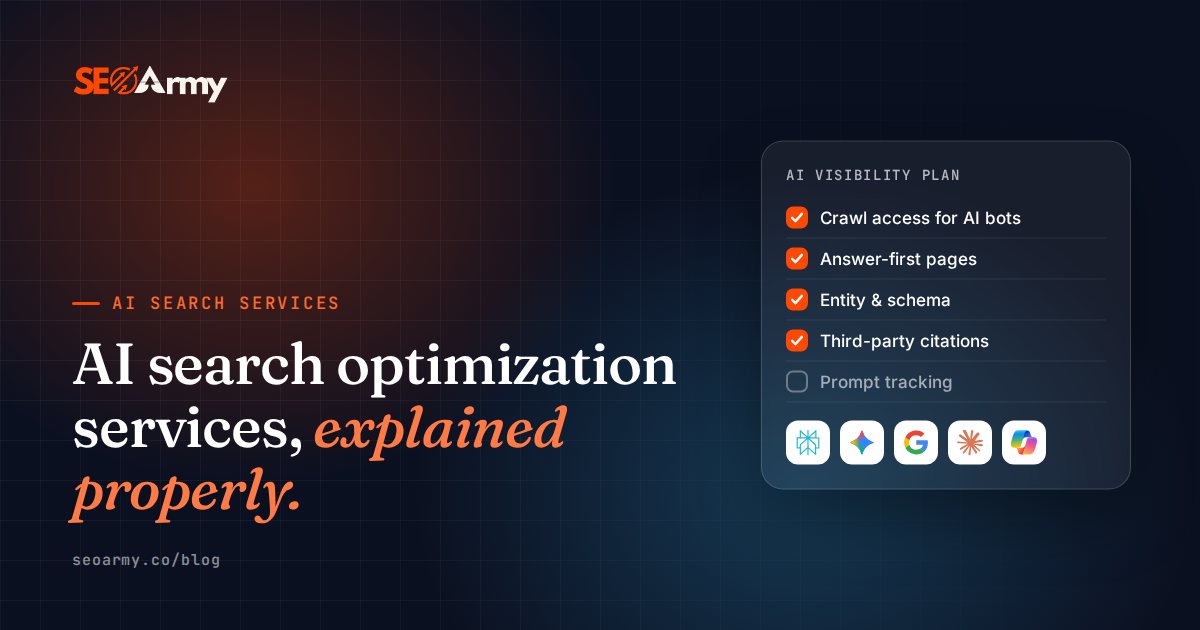
In practice a competent service covers five things: making your content legible to machines, establishing your business as a recognized entity, earning citations on the sources assistants trust, monitoring what assistants actually say about you, and feeding that back into what you publish next.
Why this matters now: the numbers
The audience moved faster than most marketing budgets. ChatGPT reported 900 million weekly users in early 2026. Google says AI Overviews reach more than 2.5 billion people a month, and the Gemini app passed 750 million monthly users. Perplexity was handling hundreds of millions of queries a month by mid-2025.
At the same time, the click is shrinking. Pew Research found that Google users who saw an AI summary clicked a traditional result in about 8% of visits, compared with 15% when there was no summary. More questions are answered on the results page or inside the assistant. Being named in that answer is increasingly what visibility means.
Want to see where you currently stand?
We build a free AI Visibility Report showing exactly which assistants mention you, which mention your competitors instead, and what is causing the gap.
Request one here →What is included, concretely
If a provider cannot map their proposal onto something like this list, they are improvising.
Content and formatting work
Answer engines extract passages. Content written as one long argument gets skipped in favor of content that states a claim, supports it, and moves on. That means direct answers near the top of a section, clear headings phrased the way people ask, tables where comparison is the point, and a willingness to be specific.
Structured data and entity work
Schema markup tells a machine what a page is rather than making it guess. Entity work goes further: making sure your organization, people, services and locations are described consistently everywhere they appear, so an assistant can connect them into one confident picture rather than several uncertain ones.
Citation and source building
Assistants disproportionately cite a handful of source types: established publications, industry directories, community discussion, and documentation. Getting represented accurately in those places moves the needle more than another blog post on your own domain.
Monitoring
You cannot manage what you cannot see. That means regularly asking the assistants the questions your buyers ask and recording what comes back — who gets named, what gets said about you, and which sources the answer leans on.
Measurement tied to revenue
AI search produces fewer clicks and more decisions. Reporting has to account for that, which means tracking assisted conversions, direct and branded traffic movement, and lead quality — not just sessions.
What it should cost
Pricing splits roughly three ways, and the right one depends on how much content and authority you already have.
- Audit only. A one-off assessment of where you appear, where you do not, and what is causing it. Low four figures. Useful if you have an in-house team who can act on it.
- Retained program. Ongoing content, entity, citation and monitoring work. Mid four figures monthly for most mid-market businesses, more where the category is competitive or the site is large.
- Project sprint. A fixed scope — usually structured data, entity cleanup and a content restructure — delivered over six to twelve weeks. Sensible when the foundations are the problem.
The honest caveat: anyone quoting you a fixed price before looking at your site is quoting a package, not a plan. The variable that moves cost most is not your revenue, it is how much usable content you already have.
How AEO differs from the SEO you are already paying for
There is real overlap, and any provider claiming otherwise is selling novelty. Good technical SEO, fast pages and genuinely useful content help in both worlds. But three things differ enough to matter.
The unit of success changes. SEO optimizes for a position. AEO optimizes for inclusion in a generated answer. You can hold position three and never be cited, and you can be cited constantly from a page that ranks eleventh.
Off-site weight increases. What third parties say about you carries more weight when a model is synthesizing consensus. Your own site is one input among many rather than the main event.
Feedback is slower and noisier. Rankings update continuously and are easy to track. Assistant answers vary between sessions, models and phrasings, so you need a sampling discipline rather than a rank tracker.
How to tell competence from improvisation
Six questions that sort providers quickly, because a real practitioner answers them without hesitating.
- “Show me an assistant answer you changed.” Not traffic — an actual before and after in what a model says. Anyone doing this work has examples.
- “How do you measure it?” If the answer is organic traffic, they are selling SEO with a new label.
- “Which sources do assistants use in my category?” This is checkable in ten minutes and reveals whether they have looked at your market at all.
- “What would you do in month one?” A real answer is unglamorous: audit, fix structured data, clean up entity inconsistencies, establish monitoring.
- “What will not work for us?” Every category has channels that do not pay back. A provider who says everything will work has not thought about your business.
- “What happens if we stop?” Honest answer: citations and entity work persist, monitoring and content velocity do not.
A realistic timeline
Structured data and technical fixes land immediately — the work is done when it ships. Entity consistency takes a few weeks to propagate as sources are corrected and re-crawled.
Citation changes are the slow part. Getting represented on the sources that assistants lean on takes 60 to 90 days in most categories, and the assistants themselves re-crawl and re-summarize on their own schedule, which adds lag on top.
Anyone promising to change what ChatGPT says about you in a fortnight is describing a coincidence, not a method.
What we do differently
Our own programs are built around the points above. Every engagement starts with a prompt set you approve and a baseline across ChatGPT, Google AI Overviews, Gemini, Perplexity, Claude and Copilot. We fix foundations before producing content, we report citation rate and share of voice alongside leads rather than traffic alone, and you own every prompt, dataset and account from day one.
If the audit shows your category does not produce recommendation answers, or that your SEO foundations need fixing first, we say so and scope accordingly. That is sometimes a smaller engagement than you expected, which is the point.
Frequently asked questions
Are AI search optimization services different from SEO services?
They overlap but they are not the same. Both benefit from sound technical foundations and genuinely useful content. AEO adds entity work, citation building on third-party sources, and monitoring of what assistants actually say — and it measures inclusion in generated answers rather than position in a list.
How much do AI search optimization services cost?
A one-off audit is typically low four figures. A retained program is usually mid four figures monthly for mid-market businesses, more in competitive categories or on large sites. Scope is driven mainly by how much usable content and authority you already have, not by your revenue.
How long before AI assistants start mentioning us?
Technical and structured data work takes effect as soon as it ships. Entity consistency propagates over a few weeks. Citation-driven changes in what assistants say generally take 60 to 90 days, plus whatever lag the assistants add through their own re-crawl cycles.
Can we do this in-house?
Yes, if you have someone who can own content structure, structured data and a monitoring routine. The parts teams usually underestimate are citation building, which is relationship work, and consistent monitoring, which is dull enough that it quietly stops happening.
Does AEO work for local businesses?
Often better than for national brands, because local categories have thinner competition in the sources assistants read. A local business with accurate listings, real reviews and clear service content is frequently the easiest thing for an assistant to recommend confidently.
Which AI platforms should AI search optimization cover?
ChatGPT and Google AI Overviews carry most of the audience, followed by Gemini, Perplexity, Copilot and Claude. One program built on a shared prompt set can cover all of them, because the underlying signals overlap heavily.
Sources & further reading
- OpenAI: ChatGPT now has 900 million weekly active users — Search Engine Land, Feb 2026
- Google CEO Pichai: AI Overviews now has over 2.5 billion monthly users — CNBC, May 2026
- Google users are less likely to click on links when an AI summary appears in the results — Pew Research Center, Jul 2025
- AI features and your website — Google Search Central
- GEO: Generative Engine Optimization (Aggarwal et al.) — arXiv / KDD 2024
- Bing Webmaster Tools officially adds AI Performance report — Search Engine Land, Feb 2026
- Creating helpful, reliable, people-first content — Google Search Central

Sully has built search-driven growth for businesses across more than 20 industries and was an early practitioner of AI search visibility, helping clients get cited by ChatGPT and Perplexity before most agencies were paying attention. Sully reviews the strategy behind every SEOArmy article. More about Sully →
Keep reading
- SEOArmyAEO Agency: how we run answer engine optimization
 Pillar GuideAI search optimization tools, compared
- What is AI search engine optimization?
- SEOArmyGet a free AI Visibility Report