

Two claims dominate the conversation about AI and search, and both are wrong. The first is that SEO is dead. The second is that nothing has changed and this is all hype. What actually happened is narrower and more interesting: a synthesis layer got added on top of retrieval, and it rewards some things traditional ranking never did.
What actually changed
For twenty years the deal was simple. A search engine retrieved a ranked list, and the user picked from it. Optimizing meant earning a higher position, because position drove clicks.
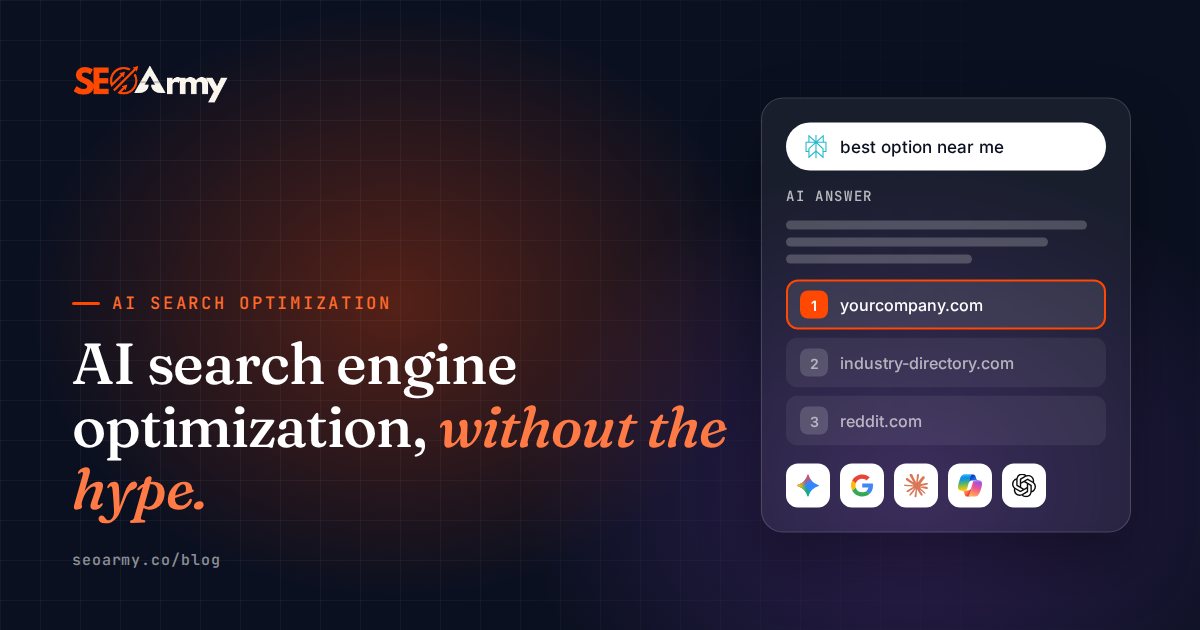
Answer engines add a step. They retrieve candidate sources, then a language model synthesizes one response and names a handful of them. The user often gets what they needed without visiting anything.
Two consequences follow. First, being retrievable is necessary but no longer sufficient — you also have to be usable in a synthesis, which rewards clear, extractable, self-contained passages. Second, the click is no longer the unit of success. Being named as the recommendation in an answer someone acts on is worth more than a visit that bounces.
The scale of the shift, in numbers
The audience for AI answers is no longer small. ChatGPT reported around 900 million weekly users in early 2026. Google says AI Overviews reach more than 2.5 billion people a month, and the Gemini app passed 750 million monthly users. Perplexity was handling hundreds of millions of queries a month by mid-2025.
Meanwhile, Pew Research found that Google users who saw an AI summary clicked a traditional result in about 8% of visits, compared with 15% without one. More questions are being answered before anyone reaches a website. That is the practical reason to care about being in the answer, not just near it.
Want the version specific to your site?
We run this analysis manually and send you the gaps, free.
Request your AI Visibility Report →How answer engines choose what to cite
Nobody outside these companies knows the exact mechanics, and anyone claiming otherwise is guessing confidently. But the observable patterns are consistent enough to work from.
Corroboration beats assertion
Claims supported across several independent sources get used. A claim that appears only on your own site is treated as a claim about you, not a fact. This is why third-party representation matters more here than it did in classic SEO.
Extractability beats eloquence
A passage that answers a question completely, in isolation, without needing the surrounding argument, is far more likely to be lifted. Long build-ups get skipped.
Recency matters more in some categories
For anything with a temporal dimension — pricing, regulation, technology, best practice — assistants visibly prefer recent sources. For stable topics it matters far less.
Entity clarity reduces risk
Models avoid naming a business they cannot confidently identify. Inconsistent names, addresses, service descriptions and categories across the web produce uncertainty, and uncertainty produces omission.
What carries over from SEO
More than the panic suggests. If your SEO fundamentals are sound, you are further ahead than you think.
- Crawlability and speed. If a crawler cannot reach or render it, no layer of this works.
- Genuinely useful content. The thing that has always worked continues to work, for the same reason.
- Authority and citations. The signals shift in emphasis but not in kind. Being referenced by credible sources still matters, arguably more.
- Structured data. Previously a rich-result play, now doing real work in helping machines understand what a page asserts.
- Local fundamentals. Accurate listings and real reviews feed both the map pack and the assistant recommending a local provider.
What genuinely differs
You optimize passages, not just pages. The extractable unit is a section that stands alone. Structure accordingly: question-shaped headings, direct answers immediately beneath them.
Off-site weight increases. When a model synthesizes consensus, what others say about you carries disproportionate weight. Your own site becomes one input among many.
Measurement gets harder. There is no rank to track and often no click to attribute. You are reduced to sampling responses and watching branded and direct traffic for movement.
Being wrong is expensive. If assistants have absorbed an inaccuracy about you — an old address, a service you dropped, a stale price — it propagates and persists.
The work, in priority order
- Fix entity consistency first. Name, address, services and descriptions identical everywhere. Cheapest work with the largest effect on whether you get named at all.
- Add and correct structured data. Organization, service, article, FAQ, local business as applicable. Make assertions explicit rather than inferable.
- Restructure key pages for extraction. Question-shaped headings, direct answers first, specifics over adjectives.
- Earn third-party representation. Directories, publications, community discussion — wherever assistants in your category actually look.
- Establish monitoring. A fixed prompt set, checked on a schedule, recorded over time.
- Then publish, informed by the gaps. Content last, because content aimed at gaps you have not measured is guesswork.
What to expect, realistically
Technical and structured data work takes effect when it ships. Entity corrections propagate over weeks as sources are updated and re-crawled. Changes in what assistants say generally follow at 60 to 90 days, sometimes longer, because the assistants re-crawl and re-summarize on schedules nobody outside them controls.
The compounding is real but slow, and it is worth being clear-eyed about the downside case too: in categories where assistants rarely make recommendations, this work has limited upside and traditional search remains the better investment. Check before committing a budget.
Platform by platform
Every major assistant works on the principles above, with differences in where it looks:
- Google AI Overviews and AI Mode draw on Google's index; rankings and Business Profile data matter most.
- ChatGPT uses search partners and OpenAI's crawler; broad corroboration and crawl access matter.
- Gemini grounds many answers in Google Search.
- Perplexity retrieves live for nearly everything and shows sources clearly; freshness matters.
- Copilot is grounded in Bing; Bing indexing and IndexNow matter.
- Claude searches the web when needed and cites what it reads.
Frequently asked questions
What is AI search engine optimization?
It is the practice of making your business retrievable and usable by AI assistants, so you get named and cited when someone asks a question your business answers. It builds on traditional SEO but optimizes for inclusion in a synthesized answer rather than for position in a ranked list.
Is AI search engine optimization different from SEO?
It overlaps heavily. Crawlability, useful content, authority and structured data matter in both. What differs is the unit of optimization (extractable passages rather than whole pages), the increased weight of third-party sources, and measurement, since there is no ranking position and often no click.
Does traditional SEO still work?
Yes. Traditional search still drives the majority of discovery in most categories, and the fundamentals feed both systems. The mistake is treating AI search as a replacement rather than an additional layer with its own requirements.
How do AI assistants decide which businesses to recommend?
The exact mechanics are not public, but observable patterns are consistent: claims corroborated across independent sources, passages that answer completely in isolation, recency in time-sensitive categories, and entities the model can identify confidently. Ambiguity tends to produce omission.
How long does AI search optimization take?
Technical and structured data changes take effect immediately. Entity consistency propagates over a few weeks. Changes in what assistants actually say typically take 60 to 90 days, plus lag from the assistants' own re-crawl cycles.
How many people use AI search?
Hundreds of millions weekly across ChatGPT alone, and Google says AI Overviews reach more than 2.5 billion people a month.
Sources & further reading
- OpenAI: ChatGPT now has 900 million weekly active users — Search Engine Land, Feb 2026
- Google CEO Pichai: AI Overviews now has over 2.5 billion monthly users — CNBC, May 2026
- Google's Gemini app has surpassed 750M monthly active users — TechCrunch, Feb 2026
- Perplexity received 780 million queries last month, CEO says — TechCrunch, Jun 2025
- Google users are less likely to click on links when an AI summary appears in the results — Pew Research Center, Jul 2025
- AI features and your website — Google Search Central
- GEO: Generative Engine Optimization (Aggarwal et al.) — arXiv / KDD 2024
- Bing Webmaster Tools officially adds AI Performance report — Search Engine Land, Feb 2026

Sully has built search-driven growth for businesses across more than 20 industries and was an early practitioner of AI search visibility, helping clients get cited by ChatGPT and Perplexity before most agencies were paying attention. Sully reviews the strategy behind every SEOArmy article. More about Sully →