


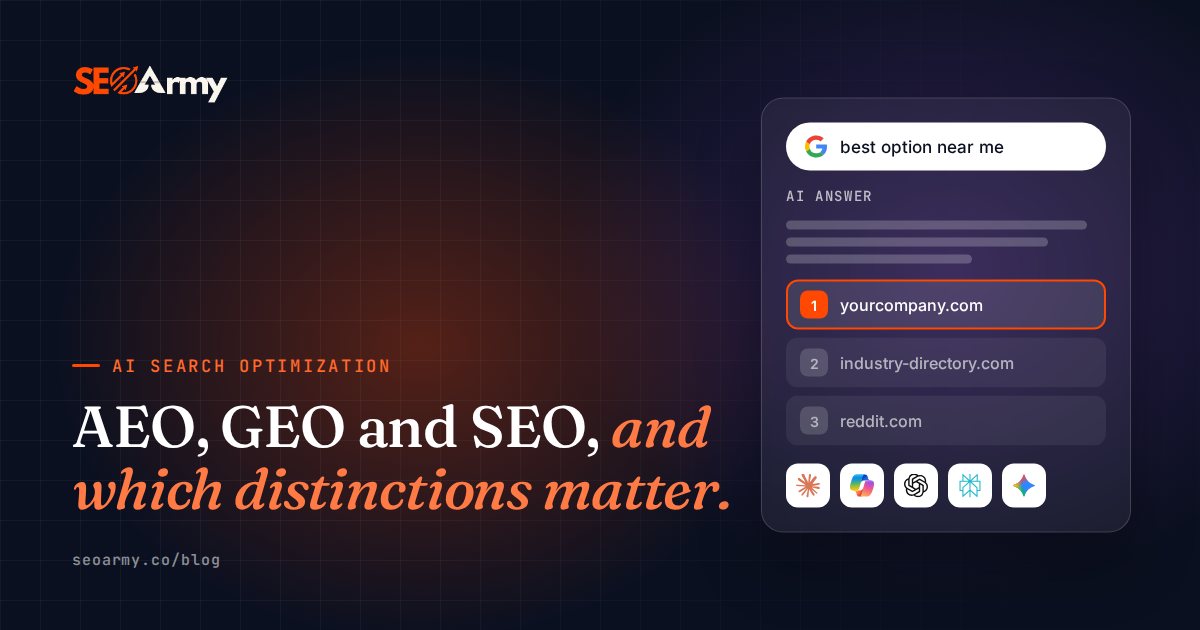
Agencies have an incentive to make these sound like three separate disciplines requiring three separate retainers. Mostly they are not. But there is one genuine distinction underneath the acronyms, and it does change what you prioritize.
What each term claims to mean
SEO optimizes for position in a ranked list of links. Established, well understood, and still the majority of discovery in most categories.
AEO, answer engine optimization, optimizes for being cited in a direct answer — featured snippets historically, AI-generated answers now.
GEO, generative engine optimization, optimizes specifically for generative systems that synthesize rather than retrieve.
In practice AEO and GEO describe nearly the same work. The distinction is largely which era of the problem the person naming it entered from.
A short history of the terms
SEO dates from the 1990s and describes optimizing for ranked lists of links. “Answer engine optimization” came into use with featured snippets and voice assistants in the late 2010s, when Google started answering questions directly above the results. “Generative engine optimization” was named in a 2023 research paper as large language models began writing answers from multiple sources.
Each term marks a point where search changed its output: from links, to extracted answers, to generated ones. The work required at each stage built on the last rather than replacing it.
Want to know where you stand?
Our free AI Visibility Report shows which assistants name you, which name competitors instead, and which sources the answers lean on.
Request one →The one difference that actually matters
It is not between the acronyms. It is between optimizing for selection and optimizing for synthesis.
Selection means a system picks your page from a set and shows it. You control what the user sees, because they land on your page. Ranking higher gets you more of that.
Synthesis means a system reads many sources, builds a new answer, and may name you inside it. You control almost nothing about presentation. What matters is whether your claim is corroborated elsewhere, whether your content is extractable, and whether the system can identify you confidently.
That difference — not the acronym — is what changes the work.
What to do about it
Do not buy three services. Ask any provider how their work changes for synthesis rather than selection. The good answers involve entity consistency, corroboration across third-party sources, and passage-level content structure. The weak answers involve publishing more blog posts.
Budget-wise, the fundamentals are shared. The incremental spend for AI search is smaller than the terminology implies, because most of it is work you should be doing anyway.
Which term to use
Use whichever your audience understands, and define it. We tend to say AI search optimization or AEO with clients, because it is the most widely searched and easiest to explain. What matters is that everyone agrees what is being measured: rankings, citations in AI answers, or both.
If a proposal uses all three terms, ask for the deliverables under each. Where they repeat, you are looking at one service described three ways.
How priorities shift in practice
The synthesis-versus-selection distinction changes priorities in concrete ways:
- Entity consistency moves from a local SEO chore to a top priority for every business.
- Third-party mentions matter even when they carry no link.
- Page structure is judged section by section, not just page by page.
- Reporting adds citation rate and share of voice alongside rankings and traffic.
- Informational content is valued for citation and trust, not only for clicks.
Frequently asked questions
What is the difference between AEO and GEO?
In practice very little. Both describe optimizing to be cited by AI systems that generate answers. AEO came from the featured-snippet era and GEO from the generative one, but the work overlaps almost entirely.
Is AEO replacing SEO?
No. Traditional search still drives most discovery, and the fundamentals feed both. AEO is an additional layer with its own requirements, not a successor.
Should I pay separately for SEO and AEO?
Usually not. Most of the work is shared, and the genuine incremental effort is entity consistency, third-party representation and monitoring. Be skeptical of anyone selling them as wholly separate retainers with separate scopes.
Is GEO a real discipline?
It is a useful name for optimizing content for generative answers, backed by published research. In practice it overlaps almost entirely with AEO and good SEO.
Which should I prioritize, SEO or AEO?
Keep SEO fundamentals in place and add the AEO layer on top. For most businesses the incremental AEO work is entity consistency, third-party representation and monitoring.
Sources & further reading
- GEO: Generative Engine Optimization (Aggarwal et al.) — arXiv / KDD 2024
- AI features and your website — Google Search Central
- Google users are less likely to click on links when an AI summary appears in the results — Pew Research Center, Jul 2025

Sully has built search-driven growth for businesses across more than 20 industries and was an early practitioner of AI search visibility, helping clients get cited by ChatGPT and Perplexity before most agencies were paying attention. Sully reviews the strategy behind every SEOArmy article. More about Sully →
Keep reading
 Pillar GuideAI search engine optimization, without the hype
- What is AI search engine optimization?