


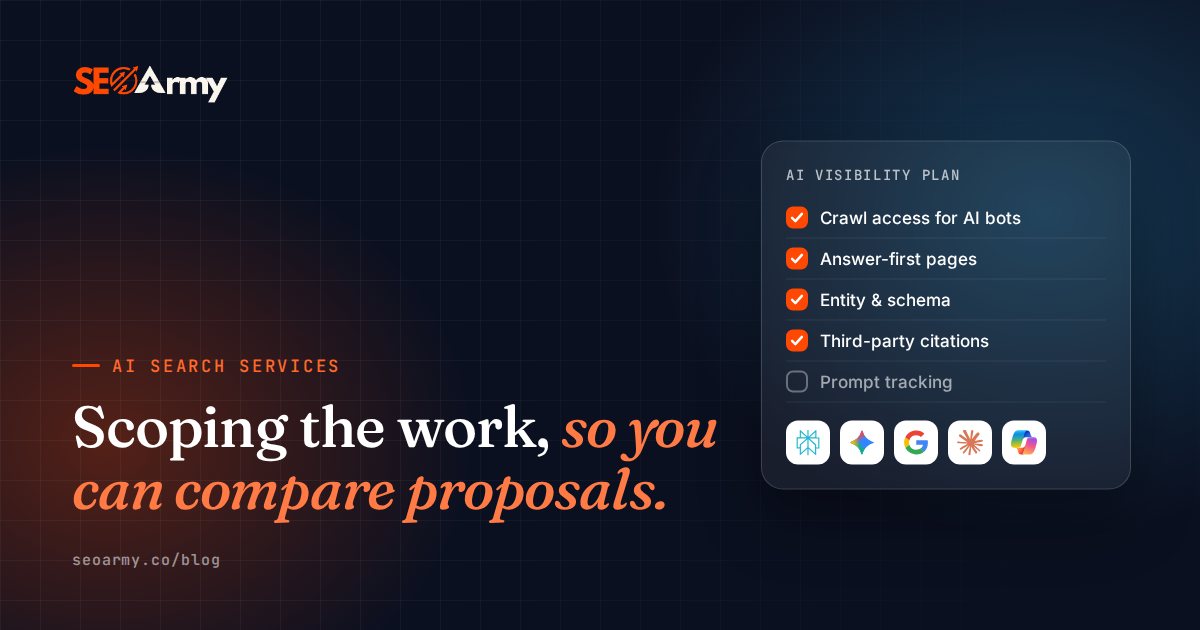
If you have three proposals for AI search work in front of you, they probably describe different things at different prices with no common structure. This is a reference scope you can map each of them onto.
Discovery and baseline
- Prompt set built from your buyers' actual questions, reviewed and approved by you.
- Baseline measurement across the major assistants, with raw responses retained.
- Source analysis identifying which domains supply answers in your category.
- Entity audit across your site, listings, directories and social profiles.
- Technical check covering crawler access, rendering and structured data validity.
Deliverables you should be able to hold in your hand
A good scope names artifacts, not activities. By the end of discovery you should have:
- The approved prompt set, as a document you own.
- A baseline sheet with raw answers, named businesses and cited URLs for every prompt and assistant.
- A source list ranking the domains that supply answers in your category.
- An entity audit: every name, address, phone and description variant found, with where it appears.
- A technical report covering crawler access, rendering and structured data validity.
- A prioritized plan for the implementation phase.
If a proposal describes discovery as “research and strategy” without listing outputs like these, ask what you will receive. The answer tells you how much discovery actually happens.
Implementation
- Entity corrections on properties you control, and requests to those you do not.
- Structured data added or corrected, validated as JSON.
- Content restructuring for extraction on agreed priority pages.
- New content, if any, aimed at measured gaps rather than keyword lists.
- Technical fixes arising from the check.
Ongoing
- Monitoring on the agreed cadence with the frozen prompt set.
- Representation and outreach work against the source list.
- Monthly reporting including citation rate with sample size, share of voice, sources gained or lost, and accuracy issues.
- Quarterly review against baseline.
What to check in any proposal
Whether the prompt set is yours or theirs. Whether raw responses are retained and exportable. Whether reporting states sample sizes. Whether entity work is included or assumed. And what happens to your data and baseline when the engagement ends.
A proposal that covers discovery, implementation and ongoing work with those five points answered is comparable to another one. Proposals that do not are not really proposals.
Scope differences by business type
The reference scope flexes by business type. Local service businesses need more weight on Business Profile work, directories and reviews. Multi-location businesses need entity work per location. Ecommerce needs product data, merchant listings and structured data at scale. B2B needs review platforms, comparison content and documentation. Regulated categories need a review step for every piece of content and outreach.
A proposal that looks identical for a dental practice and a software company is not scoped. It is a package, and the work that matters most for your business type is likely to be light or missing.
Service levels worth writing down
Beyond deliverables, agree a few service levels: how quickly the agency responds to an inaccuracy found in an assistant answer, how often raw monitoring data is shared, and how long implementation items can wait in your developers' queue before they are escalated.
Those sound administrative, and they are. They are also what separates an engagement that keeps moving from one where a quarter passes waiting on a schema change nobody chased.
Red flags in a scope
Be cautious of scopes built around volume (a fixed number of articles per month), guarantees of AI placements, prompt sets you cannot see, or no mention of entity work. Each suggests the provider is selling what is easy to deliver rather than what moves outcomes.
Frequently asked questions
What should AI search optimization services include?
Discovery and baseline (approved prompt set, measurement, source analysis, entity audit, technical check), implementation (entity corrections, structured data, content restructuring, technical fixes), and ongoing monitoring, outreach and reporting.
How do I compare AEO proposals?
Map each onto a common scope, then check five things: whose prompt set it is, whether raw responses are retained and exportable, whether reporting states sample sizes, whether entity work is included, and what happens to your data at the end.
What is usually missing from AEO proposals?
Entity work, which is frequently assumed rather than scoped, and any statement about data ownership at the end of the engagement. Both are worth asking about explicitly.
How long should discovery take?
For most small and mid-sized businesses, two to four weeks. Longer usually means access problems or an unusually messy entity footprint, both worth knowing about.
Should implementation be included in an AEO scope?
Either included or explicitly assigned to your team. The worst outcome is a scope where recommendations are delivered and nobody is responsible for doing them.
Sources & further reading
- AI features and your website — Google Search Central
- Introduction to structured data markup — Google Search Central
- Introduction to robots.txt — Google Search Central
- Bing Webmaster Tools officially adds AI Performance report — Search Engine Land, Feb 2026

Sully has built search-driven growth for businesses across more than 20 industries and was an early practitioner of AI search visibility, helping clients get cited by ChatGPT and Perplexity before most agencies were paying attention. Sully reviews the strategy behind every SEOArmy article. More about Sully →
Keep reading
 Pillar GuideWhat AI search optimization services should cost
- How to choose an AEO agency
 GuideWhat AEO agencies charge, and why