


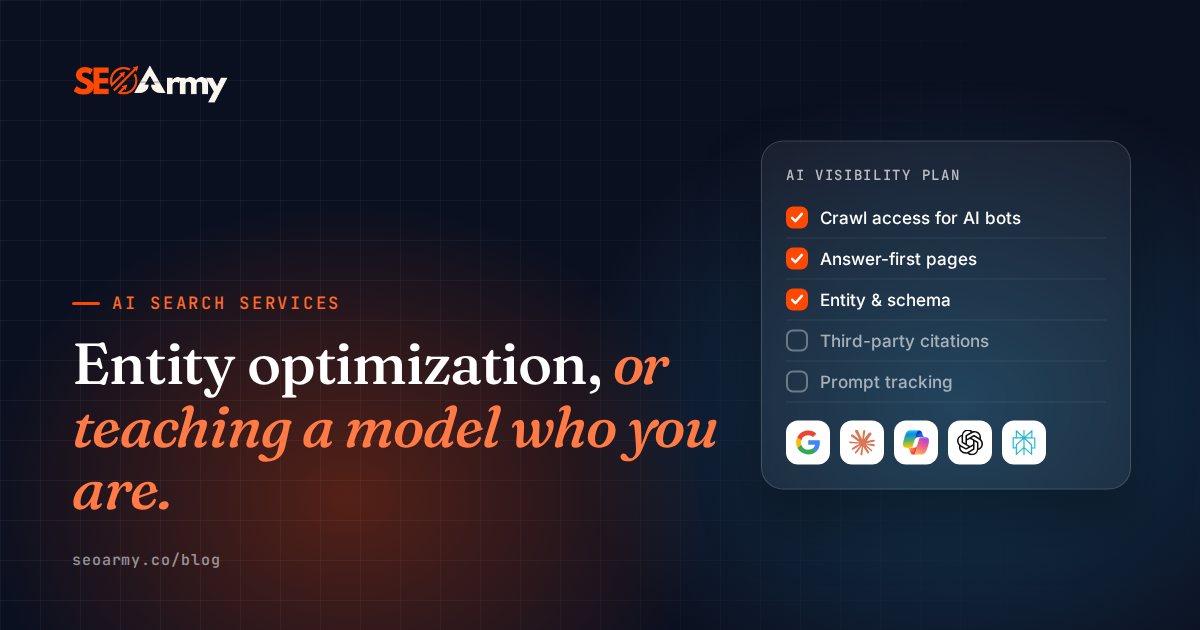
There is a failure mode that looks like bad luck and is actually a data problem: assistants simply do not mention you, even for questions you should obviously answer. Frequently the cause is not authority or content. It is that the model cannot tell with confidence which business you are, and uncertainty resolves as omission.
What an entity is, practically
An entity is a thing a system can identify and hold facts about: your company, your people, your locations, your services. The model builds that picture from every mention of you it has seen, and its confidence depends on those mentions agreeing.
When they disagree — a different legal name here, an old address there, a service you no longer offer listed somewhere else — the model is left with several competing partial pictures rather than one solid one. Faced with that, naming you is a risk it tends not to take.
The consistency audit
Pick your canonical facts first and write them down: legal name, trading name, address format, phone, service list, founding year. Then check every place they appear.
- Your own site: footer, contact page, about page, schema markup.
- Google Business Profile and any other map listings.
- Industry directories and association memberships.
- Social profiles, including ones nobody has logged into for years.
- Review platforms.
- Press mentions and partner sites, where you can request corrections.
- Old domains and defunct microsites, which are a common source of contradictions nobody remembers.
The output is a list of contradictions. Fixing them is unglamorous administrative work and is routinely the highest-return task in an AEO engagement.
Want this checked for your site?
Our free AI Visibility Report runs these checks manually and shows you the gaps.
Request one →Writing down the canonical facts
Before fixing anything, create a one-page fact sheet that becomes the reference for everyone. Include the exact business name (and whether “Inc.” or “LLC” is shown publicly), address in one format, main phone number, website URL, founding year, short and long descriptions, service list in customer language, service areas, hours, owners or key people with titles, and links to official profiles.
Share it with whoever touches listings, PR, partnerships or the website. Most new inconsistencies are created by well-meaning people improvising a description because they could not find the official one.
Linking the entity together
Once the facts agree, connect them. sameAs properties in your Organization schema pointing to your verified profiles do this explicitly. Consistent naming across those profiles does it implicitly.
For people, the same applies: a consistent author identity across your site, professional profiles and any published work makes attribution resolvable, which matters increasingly as models weigh who is making a claim.
How long it takes to show up
Corrections propagate at the speed of whoever holds the data. Your own site is immediate. Listings you control update in days. Third-party sources depend on their review process and can take weeks or refuse entirely.
Assistants then need to re-crawl and re-summarize, which adds its own lag. Sixty to ninety days before the effect is visible in answers is a realistic expectation, which is why this work should be first rather than last.
Knowledge graph and third-party entity sources
Beyond your own listings, a few sources carry unusual weight in how systems understand entities. Wikidata and Wikipedia are the obvious ones, but notability rules mean most small businesses should not try to create entries. Industry associations, licensing boards, chambers of commerce, Crunchbase for startups, and manufacturer dealer directories are realistic alternatives.
What matters is that each description agrees with the others and with your site. A licensing board entry under a legal name that appears nowhere else, for example, is worth linking to from your about page with a sentence explaining the relationship.
People are entities too
For professional services, the practitioners often matter as much as the business. A dentist, attorney, financial adviser or consultant with a consistent name, credentials and biography across the practice site, professional directories and publications is easier for an assistant to describe accurately, and to recommend.
Give each key person a profile page with Person markup, link it to their professional profiles with sameAs, and use the same headshot and credential wording everywhere. It is the same consistency work, applied to individuals.
Frequently asked questions
What is entity optimization in SEO?
Making your business identifiable and consistently described everywhere it appears, so search and AI systems can resolve scattered mentions into one confident entity. It covers name, address, services, people and the links that connect your profiles to each other.
Why do AI assistants not mention my business?
Frequently because they cannot identify you confidently. Contradictory names, addresses or service descriptions across your site, listings and directories produce competing partial pictures, and models tend to resolve that uncertainty by omitting you rather than guessing.
How long does entity cleanup take to work?
Your own site updates immediately, listings you control within days, third-party sources over weeks or not at all. Assistants then re-crawl on their own schedule, so 60 to 90 days before the effect shows in answers is realistic. That lag is why this work belongs at the start.
Should my business have a Wikipedia page?
Only if it meets Wikipedia's notability guidelines through independent coverage. Creating one without that coverage usually ends in deletion and can look promotional.
What if my business changed its name?
Update every listing you control, request updates elsewhere, 301-redirect old domains, and explain the change on your about page, for example 'formerly known as'. That helps systems connect the old and new names.
Sources & further reading
- Organization structured data — Google Search Central
- Introduction to structured data markup — Google Search Central
- Guidelines for representing your business on Google — Google Business Profile Help
- How Google determines local ranking — Google Business Profile Help

Sully has built search-driven growth for businesses across more than 20 industries and was an early practitioner of AI search visibility, helping clients get cited by ChatGPT and Perplexity before most agencies were paying attention. Sully reviews the strategy behind every SEOArmy article. More about Sully →
Keep reading
- Structured data for AI search: what gets read
 Pillar GuideWhat AI search optimization services should cost
- SEOArmyOur AEO agency services