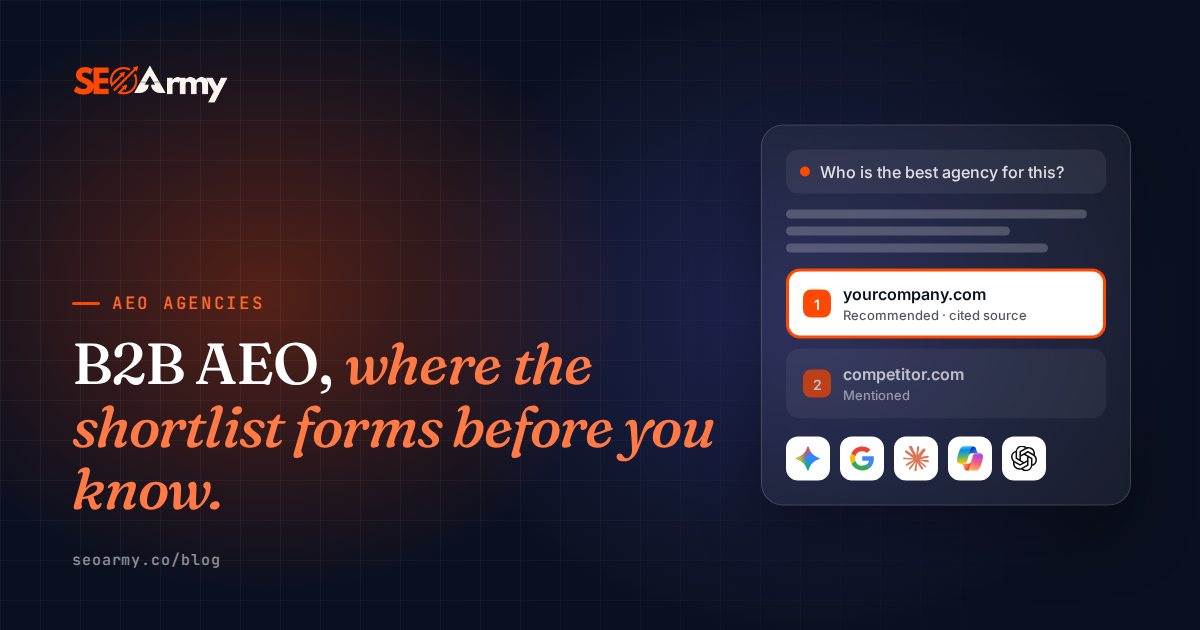



Assistants are unusually good at software comparisons, because the category is well documented, heavily reviewed and discussed constantly by practitioners. That confidence means buyers accept the shortlist, which makes presence in it disproportionately valuable.
What assistants use for software questions
Review platforms first, for category placement, ratings and the specifics reviewers mention. Then comparison and alternatives content, much of it published by competitors. Then practitioner discussion in communities. Then documentation, which is unusually citable because it is precise and structured.
Vendor marketing sites contribute comparatively little, which is uncomfortable given where most SaaS content budget goes.
Pricing pages and AI answers
One of the most common SaaS questions buyers ask assistants is some form of “how much does X cost” or “which is cheapest for a team of twenty”. If your pricing is behind a sales call, the assistant fills the gap with whatever third parties have written, which is often out of date or wrong.
Even if you cannot publish full prices, publish the structure: what the plans are, what drives cost, which features are in which tier, and a starting point. State the date it was last updated. That gives assistants a current primary source to quote, and gives buyers a reason to trust the rest of the page.
Want your baseline?
Our free AI Visibility Report shows where you appear and where you do not.
Request one →Documentation as a citation asset
This is the most underused opportunity in SaaS AEO. Public documentation is specific, structured and written to answer questions exactly — the ideal shape for extraction.
Making docs public rather than gated, ensuring they are crawlable, and writing them in question-shaped sections turns an engineering artifact into a visibility asset. It also tends to be accurate, which marketing content is not always.
Being in comparisons you did not write
- Own your alternatives pages. If competitors publish “alternatives to you” and you publish nothing, their framing is the only one available.
- Publish honest comparisons. Including where you are not the right choice. Assistants pick up nuance and buyers trust it more than a page claiming universal superiority.
- Keep review platform profiles current. Category placement, feature lists and pricing there are read as fact.
- Participate in communities properly. Practitioner discussion is heavily weighted precisely because it reads as disinterested, which means undisclosed promotion is both wrong and counterproductive.
Changelogs and release notes
Assistants often repeat outdated limitations, such as a missing integration or an old restriction, long after they have been fixed. Public, dated release notes and a clear changelog help correct that, because they give retrieval-based assistants a recent, specific source that contradicts the old claim.
Pair them with updates to the places the old claim came from: your review platform profiles, integration marketplaces, partner directories and your own comparison pages. The correction lands faster when several sources agree.
Measuring SaaS AI visibility
Build the prompt set from real buying moments: category questions (“best tools for”), alternative questions (“alternatives to” each main competitor), integration questions (“works with” your key integrations), and pricing questions. Track which vendors appear, how you are described, and which review and comparison sites are cited.
Then connect it to the funnel. Add “how did you hear about us” to signup and demo forms, tag trials that arrive from assistant referrers, and ask sales to note when prospects mention an assistant. Together those show whether visibility is turning into pipeline.
Integrations and marketplaces
Integration marketplaces and partner directories are frequently cited in software answers. Keep your app listings on the platforms you integrate with complete and current, with the same product description and categories as your own site.
Frequently asked questions
How do SaaS companies get recommended by AI assistants?
Mainly through review platforms, comparison content including competitors', practitioner community discussion and public documentation. Vendor marketing sites contribute relatively little to software recommendation answers.
Should SaaS documentation be public for AI search?
Yes where possible. Documentation is specific, structured and question-shaped, which makes it unusually citable. Gating it removes one of the strongest citation assets a software company has.
Do alternatives pages matter for SaaS?
Substantially. If competitors publish alternatives pages naming you and you publish none, their framing is the only version available to an assistant summarizing the category.
Should SaaS companies publish pricing for AI search?
Where possible, at least the structure and a starting point. Otherwise assistants rely on third-party estimates, which are often outdated.
How do I fix outdated information about my software in AI answers?
Publish dated, specific corrections on your own site (release notes, docs, pricing) and update the third-party profiles the assistants cite. Corrections propagate as those sources are recrawled.
Sources & further reading
- GEO: Generative Engine Optimization (Aggarwal et al.) — arXiv / KDD 2024
- Organization structured data — Google Search Central
- Introducing ChatGPT search — OpenAI
- Bing Webmaster Tools officially adds AI Performance report — Search Engine Land, Feb 2026

Sully has built search-driven growth for businesses across more than 20 industries and was an early practitioner of AI search visibility, helping clients get cited by ChatGPT and Perplexity before most agencies were paying attention. Sully reviews the strategy behind every SEOArmy article. More about Sully →